
Running a 360 booth at a wedding
A wedding is not a four hour block. It is a sequence with speeches, dinner and dancing in it, and almost everything operators get wrong here comes from ignoring that.
Weddings are the most common booking a 360 booth gets, and the easiest to run
badly while thinking it went fine.
The mistake is almost always the same one. An operator quotes four hours,
arrives, sets up, and waits. But a wedding is not four hours of the same thing.
It is a sequence, and the booth is competing with parts of it.
The person paying is not the person using it
Start here, because it explains most of what follows.
The couple booked you. The couple will use the booth once, briefly, if at all.
They are being photographed, moved around, talked to, and fed on a schedule
they do not control. Their experience of your booth is almost entirely what
their guests tell them afterwards and what they see the next morning.
Two consequences worth building around.
Your actual users are the guests. Brief them, manage the queue for them,
make it easy. That is what gets reported back.
Your client experiences your work after the event. The clips arriving
promptly and looking good is most of what they are buying, even though it feels
like the night is the deliverable.
When do wedding guests actually use the booth?
Guests do not arrive at a booth evenly, and at a wedding the pattern is
reliable enough to plan around.
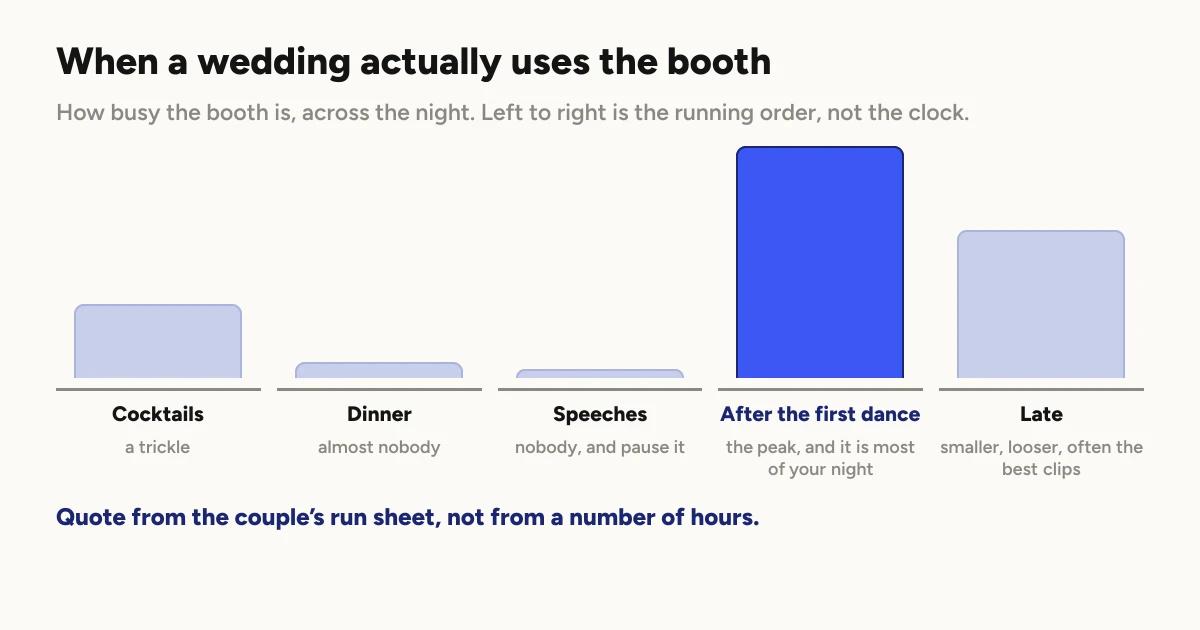
Cocktail hour or the gap after the ceremony. A trickle. People are still
finding each other and holding drinks. Good for warming up, not much volume.
During dinner and speeches. Nearly nothing. People are seated and it would
be rude to leave.
Right after the first dance, once the floor is busy. This is the peak, and
it is a big one. A large share of your whole night happens inside this one
window, which is shorter than the number of hours you quoted.
Late. A second smaller wave, looser and more fun, and often the best clips
of the night.
If your hours are chosen badly, you can be packing down as the peak begins.
When a couple asks how many hours they need, the honest answer is not a number
of hours, it is which parts of the night you want covered, and that is a
better conversation anyway.
What do you do during speeches and the first dance?
A 360 booth is loud. Not the machine, the people. There is music, there is a
queue, and there is a group of guests laughing at a replay.
During speeches and the first dance, none of that can be happening. Agree in
advance that the booth pauses, and tell guests as it approaches rather than
turning them away mid-queue.
Nobody will complain to you about this on the night. It will come up later, in
the way that costs you a recommendation from the venue and the photographer.
Why are weddings harder on your clips?
Two things about a wedding reception work against the footage.
The room is usually dark by the time the booth is busy. Dinner lighting
becomes dancing lighting, and the peak arrives at the darkest part of the
night. This is why bringing your own light matters more at a wedding than at
almost any other event. The reasoning is in
lighting a 360 booth.
Guests are dressed for it. Long dresses, heels, suit jackets and drinks in
hand. Stepping onto a raised platform is genuinely harder for some guests than
it looks. Keep a hand available, keep the platform low if you can choose, and
do not rush anybody.
What do guests need to be told?
Slow motion only rewards movement, and a group of well dressed adults will
default to standing still and smiling. Your briefing is what fixes it, and at a
wedding it has to be short and warm rather than instructional.
Things that work: hold up your drinks, throw the confetti, do the thing you did
at the ceremony, spin her, all lean in. Things that do not work: "just be
natural", which produces four people standing rigidly.
Groups of two or three look better than groups of six. The platform is small
and the arm is close.
Should you collect guest contacts at a wedding?
This is the biggest single difference between a wedding and a corporate booking,
and it changes what you should even be trying to do.
The guests are the couple's family and friends. They are not leads. Pushing
contact capture at a wedding reads as commercial and it is the one thing most
likely to annoy the person who booked you.
The requests worth using are the light ones. A follow request costs a guest one
tap and is genuinely how this format grows. A review request, if you use one at
all, belongs with the couple after delivery rather than with a guest at the
booth.
What the client actually wants is the clips. Agree in advance whether they
get the full set, and how. That question is asked at almost every wedding
enquiry, and having a clear answer makes you look like you have done this
before.
What should you ask before you quote?
Four things, and they are all conversations rather than equipment.
Ask for the run sheet. Ceremony, dinner, speeches, first dance. Your hours
follow that, not the other way round.
Ask where the booth is going and what the lighting is there. Covered in
what venues ask for, and what to ask them.
Ask who gets the videos, and say when. Then beat the date you gave.
Ask what the couple actually want from it. Some want a keepsake, some want
their guests entertained during a long gap. Those are different jobs and they
change where you put the booth.
The short version
Plan around the sequence, not the clock. Bring your own light because the peak
is the darkest part of the night. Brief guests warmly and briefly. Pause for
speeches without being asked.
And remember that the person who booked you will mostly judge the night by what
arrives afterwards, which means delivery is not the boring administrative part.
It is the part they see.
Keep reading
What is a 360 video booth?
Two names, mostly one product. A 360 video booth and a 360 photo booth are usually the same machine, but a plain video booth is something else entirely. Here is how to tell what you are looking at.
Read more →
Snap360 alternatives, compared
Snap360 is a capable 360 booth app with an unusually generous free tier. The differences worth knowing are cloud storage, how many devices you can run, and what offline actually means.
Read more →
Your first 360 booth event: what actually happens
Most advice for new operators stops at the sale, because most of it is written by people selling rigs. This is the part after that, in the order it actually happens.
Read more →