
Lighting a 360 booth so the clips actually look good
A 360 booth asks more of light than a normal camera does, and for two reasons that stack up. The camera travels through every direction, and slow motion needs more light than normal speed.
Almost every guide to buying a 360 booth, including ours, tells you that
lighting is the biggest quality upgrade available and then moves on to the next
thing. That is not much help when you are standing in a dark reception room an
hour before doors.
So here is the part that usually gets skipped. Not a shopping list, because the
right light depends on your rig and your venues. The reasoning, so you can make
the call yourself.
Why is a 360 booth a harder lighting problem?
A static photo booth points one way. You light that one direction and you are
done.
A 360 booth does not have one direction. The arm carries the camera all the way
around the guest, so every direction becomes the camera's direction at some
point in the take. That single difference is what makes lighting a 360 booth
its own problem.
Put one bright light on one side and you have built a good clip and a bad one
in the same take. For the part of the arc where the light is behind the
camera, the guest is lit. For the part where the light is behind the guest,
the camera is shooting into it, and your guest is a silhouette. Same take, same
light, opposite results, because the camera moved and the light did not.
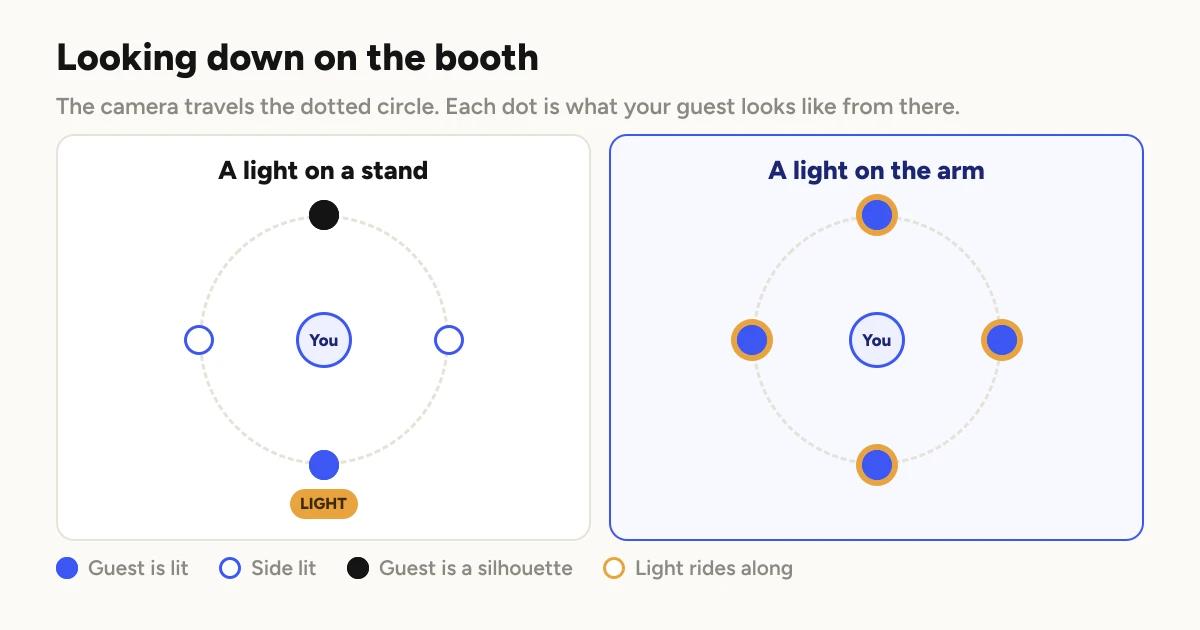
That is the reason arm-mounted lights are standard on these rigs rather than a
nice extra. A light fixed to the arm travels with the camera. It is in front of
the guest for the whole circle, so there is no part of the arc where it is
working against you.
The second reason, which nobody mentions
Slow motion needs more light than normal speed.
Recording for slow motion means capturing many more images every second, and
each of those images gets a shorter slice of time to collect light. Less time
per image means less light per image. The camera compensates by amplifying what
it did get, and amplification is where noise comes from. That grainy, muddy
look in a dim room is not a cheap phone. It is a camera being asked to make a
picture out of very little.
Which leads somewhere slightly uncomfortable: the effects people buy a 360
booth for are the ones that need the most light. A dramatic slow ramp in a
dark room is the hardest thing you can ask of the setup. The same effect in a
well lit room is the shot that sells your next booking.
If you take one thing from this article, take that one. Lighting is not about
making the room pretty. It is about giving the camera enough to work with so
the effect you are selling actually lands.
Do you need one light or two?
Once you see it this way, the setup stops being guesswork.
The guest is one job. This is the arm light, or a light close to the booth
aimed at where people stand. It has to be even, it has to be in front, and it
has to be bright enough for slow motion. This is the light that decides whether
your clips look professional.
The background is a different job. This is the room. Uplighting, festoon,
whatever the venue has. You are rarely in control of it and you mostly do not
need to be. It sets the mood and it fills in the space behind the guest.
Operators get into trouble when they expect the venue to do the first job. It
almost never does. Venue lighting is designed for a room full of people who are
looking at each other, not for a camera moving in a circle at speed.
What will venue lighting do to your clips?
Worth knowing in advance, because you can usually see it during setup.
Dim rooms produce noisy footage. No rig fixes this and no software fully
fixes it either. This is the one to plan around.
Coloured lighting shifts skin tones. A room washed in deep blue or magenta
will tint your guests. A bright neutral light near the booth pulls them back
towards looking like themselves, because it becomes the dominant light on their
face while the colour stays in the background where it looks good.
Anything behind the guest fights you. A window in daylight, a bright bar, a
stage wash. For part of the arc the camera is looking straight at it.
Some venue lights flicker on camera. If you get dark bands rolling through
your clips, that is a specific fault with a specific cause and a setting that
fixes it. It is not your light and it is not your phone. That one has its own
article: why your 360 clips flicker.
What should you check when you arrive?
None of this needs equipment. It needs five minutes before guests arrive.
Record a test take and watch the whole thing. Not a preview, a real take
with the effect you plan to run. The problems in this article all appear in the
part of the arc you were not looking at.
Walk the arc. Stand where the guest stands and look where the camera will
be. Anywhere you are squinting into a light is a part of the clip where your
guest is a shadow.
Check the darkest point, not the average. A room can look fine and still
have one side of the booth much darker than the other.
Look at a face, not the room. The clip is of a person. If their face is
noisy or tinted in the test take, no amount of good room ambience will save it.
The honest summary
Light the guest yourself and let the venue light the room.
Everything else follows from the two facts at the top. The camera travels
through every direction, so your light needs to travel with it or wrap evenly
enough that direction stops mattering. And slow motion is hungry for light, so
the moment you are selling is the moment with the least margin.
It is also, still, the cheapest visible upgrade available to you. Light is the
one part of this setup you can add to. You cannot add a bigger sensor to the
phone, and you cannot make the venue brighter by buying a better arm. That is
the whole reason the advice keeps getting repeated, and it is worth choosing a
booth phone with that order of
priorities in mind.
Keep reading
What is a 360 video booth?
Two names, mostly one product. A 360 video booth and a 360 photo booth are usually the same machine, but a plain video booth is something else entirely. Here is how to tell what you are looking at.
Read more →
Snap360 alternatives, compared
Snap360 is a capable 360 booth app with an unusually generous free tier. The differences worth knowing are cloud storage, how many devices you can run, and what offline actually means.
Read more →
Your first 360 booth event: what actually happens
Most advice for new operators stops at the sale, because most of it is written by people selling rigs. This is the part after that, in the order it actually happens.
Read more →