
Your first 360 booth event: what actually happens
Most advice for new operators stops at the sale, because most of it is written by people selling rigs. This is the part after that, in the order it actually happens.
The rig arrived, you have practised in the living room, and there is a date in
the calendar. Almost everything written for you at this point was written by
somebody selling equipment, which means it stops at the moment you own it.
This is the part after that, in the order it happens rather than as a list of
tips. What a first-timer lacks is not information, it is a sense of sequence.
What should you sort out the week before?
All of it is conversations, none of it is equipment, and all of it gets harder
the closer you get to the day.
Get the run sheet. What time things happen, and specifically what the big
moments are. Your hours should sit around them rather than starting when you
feel like arriving.
Confirm where the booth is going, and ask what the lighting is like in that
exact spot. Not the room. The corner.
What venues ask for, and what to ask them
covers the full list, including the questions that only have useful answers if
you ask them early.
Ask about wifi in that corner, and assume the answer is worse than you are
told. Decide now what happens if there is none, because that is a setup
decision rather than something you fix live.
Send the venue whatever they need. Insurance, arrival time, what you are
bringing. Suppliers who send things before being chased get recommended.
Agree who gets the clips and by when, then plan to beat the date you gave.
What should you actually pack?
The rig is the obvious part. These are the ones first-timers leave behind.
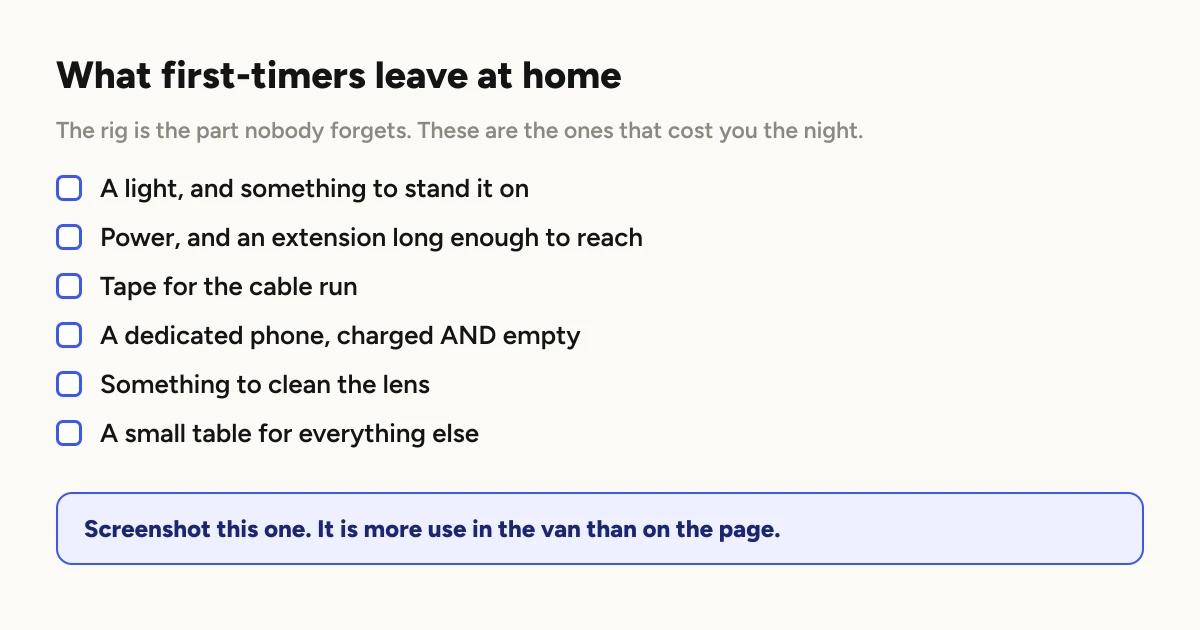
A light, and a stand for it. The most important thing in the bag after the
booth itself. Venues are darker than they look and the busy part of the night
is usually the darkest part.
Power, and a long extension. The socket is never where the booth is. Treat
the cable as booth equipment you check, not as something you borrow on arrival.
Tape for the cable run. Somebody will walk across it.
A dedicated phone, charged and empty. Empty matters as much as charged.
Clips are large and they stay on the phone until they upload.
Something to clean the lens. An hour of guests leaning in leaves marks, and
nobody checks.
A small table. For your things, for props, for the phone when you are not
holding it.
How early should you arrive?
Earlier than the job needs, on your first one.
You are not just building the booth. You are finding the socket, deciding where
the light goes, working out where the queue will form, and discovering whatever
this particular room is going to do to you. All of that is free if you have
time and expensive if you do not.
Setup order that works:
Booth first, in the spot you agreed, with clearance for a full circle at
the arm's widest point.
Power and cable run second, taped down as you go.
Light third, because you cannot judge it until the booth is where it is
going to be.
Then your settings, before anything else, because they are baked at render
time rather than adjustable afterwards.
What should you check before the first guest?
One thing, and it catches almost everything.
Record a real test take and watch the whole thing back. Not a preview. A
full take with the effect you intend to run, watched all the way through.
This is the single most valuable habit in the job. It catches lighting,
flicker, framing, and whether the settings are what you think they are, in the
one window where you can still change them. Nearly every fault described in
what goes wrong at a 360 booth is
visible in a test take and invisible in the room.
Then check your storage, and put the phone on power.
What happens in the first hour?
Less than you expect, and that is normal.
Guests do not use a booth because it is there. They use it because they have
seen somebody else use it and enjoy it. The first hour is usually slow and the
trap is reading that as failure and starting to push.
What works is getting a few good groups through early. Ask the people already
nearby. Once there is a clip playing back and people laughing at it, the queue
builds itself.
What does not work is standing behind the booth waiting. You are part of the
attraction on your first night whether you like it or not.
What do you say to guests?
Something, and something short.
Slow motion only rewards movement. A group told to "just be natural" will stand
still and smile, and the clip will be an expensive photograph. A group told to
do something with their hands will move, and the clip will work.
Keep it to a few words, keep it warm, and count them in. Two or three people
per take looks better than six, because the platform is small and the arm is
close.
What should you do at the end of the night?
The night is not over when the guests leave.
Do not clear the phone. Not yet, and this is the one that causes permanent
loss. Clips that have not finished uploading exist only on that device.
Let the uploads finish before you pack the phone away, or before you leave
if the venue connection is doing the work.
Leave the space as you found it. Tape up, cables gone, nothing left.
Say thank you to whoever ran the room, and ask whether they keep a list of
suppliers they recommend. Right after a night that went well is the only easy
time to ask.
What should you do the next morning?
Deliver, and deliver early.
Your client experiences almost all of your work after the event. They were busy
during it. What they actually judge is what arrives afterwards and how quickly.
Beating the date you promised is the cheapest reputation you will ever buy.
Then, while it is fresh, write down what happened. What you forgot, what the
room did that you did not expect, what you would set up differently. Your
second event is much easier than your first, but only if you capture the first
one before it fades.
The short version
Sort the conversations out the week before, arrive earlier than you need to,
record a test take and actually watch it, expect a slow first hour, and do not
clear the phone until the uploads are done.
Everything else you will learn on the night, which is fine. It is the things
decided before guests arrive that you do not get a second chance at.
Keep reading
What is a 360 video booth?
Two names, mostly one product. A 360 video booth and a 360 photo booth are usually the same machine, but a plain video booth is something else entirely. Here is how to tell what you are looking at.
Read more →
Snap360 alternatives, compared
Snap360 is a capable 360 booth app with an unusually generous free tier. The differences worth knowing are cloud storage, how many devices you can run, and what offline actually means.
Read more →
What goes wrong at a 360 booth, and how to fix it
Search for help with a 360 booth and you mostly get results about Apple's Mac Photo Booth app. This is the operator version, organised by what you can actually see.
Read more →