
How to make a photo booth overlay that actually fits
Get the shape wrong and your artwork is stretched across every clip of the night, with nothing warning you. Here is the order to do this in.
An overlay is the artwork that sits on top of every clip: the couple's names,
the company logo, the event title, the border. It is the single thing that
makes a clip look like yours rather than like any other booth's.
It is also the easiest thing to get subtly wrong in a way you do not notice
until the event is over.
The short answer: make the artwork to match the booth's shape, not the other
way round. If they disagree, the artwork loses, and it loses on every clip of
the night.
Which clip shape should you design for?
Before you open a design tool, check what shape the booth is set to. It is
Clip shape in Booth Settings, and it will read one of two things:
Portrait 9:16 (1080 x 1920) or Landscape 16:9 (1920 x 1080)
That label carries the pixel size on purpose. It is the number you paste into
your canvas, and it is the whole reason to look before you design rather than
after.
The shape is set per booth. A two booth event can genuinely run one of each,
which means two pieces of artwork, not one.
Portrait or landscape covers how
to decide which.
What happens if the shape and the artwork disagree?
Worth knowing exactly, because it is not what most people assume.
The artwork is stretched to fill the frame. It is not cropped, and it is
not letterboxed with bars. A 1080 x 1920 overlay on a landscape clip gets
squashed horizontally into 1920 x 1080: circles become ovals, text gets fat,
and a border that was even is suddenly thick on two sides and thin on the other
two.
Nothing warns you when you pick the file. The app takes whatever you give
it. The only related warning is on the recorder, and it is about something
else: it tells you when the phone is mounted against the booth's setting, not
when your artwork is.
So the check has to be yours, before the event.
Why should the middle be left empty?
The rule that matters most, and it applies to both shapes.
Guests appear in the middle of the frame. Anything you put there covers them,
and covering the people is the one thing an overlay must never do. Put the
artwork near the edges and leave the centre clear.
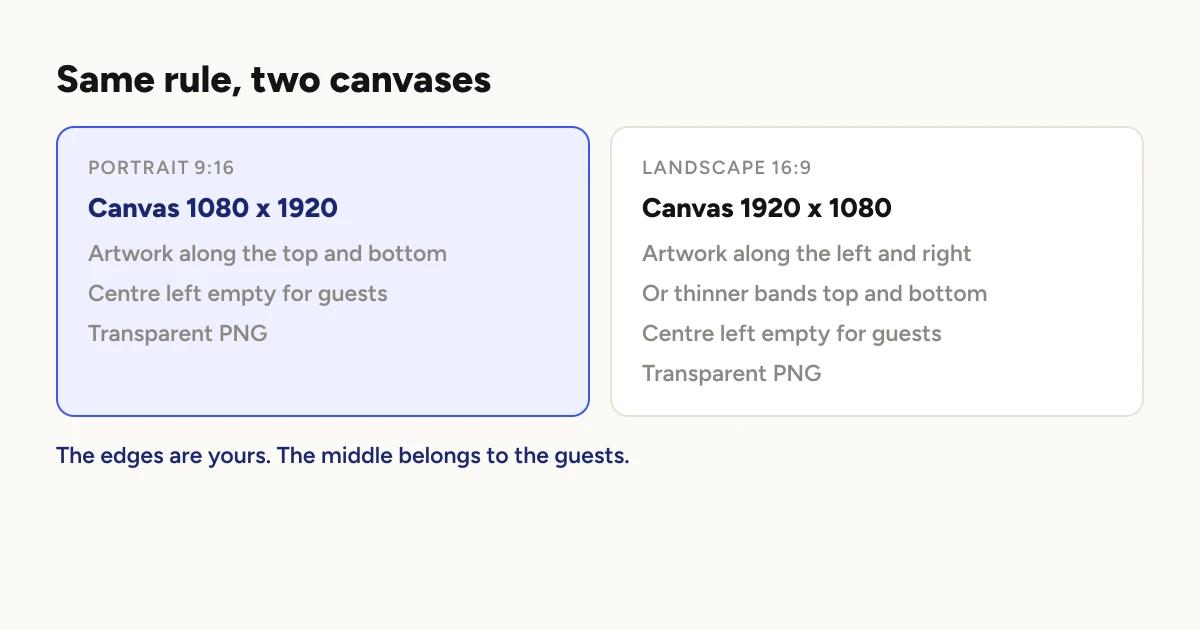
In portrait that usually means a band across the top and another across the
bottom. In landscape the tall edges are shorter, so the same amount of artwork
sits better on the left and right, or as thinner bands top and bottom.
This is the reason a landscape overlay is not simply a rotated portrait one.
The empty area has a different shape, so the design has to be redrawn rather
than turned.
What file does the overlay need to be?
A PNG with a transparent background. A JPG has no transparency, so it will
cover the whole clip in a solid rectangle.
Exactly the pixel size on the label. Not "about right", not a bigger
version to be safe. The size on the label.
Check it on a dark background before you export. Transparent areas look
white in most design tools, which makes it easy to leave a white box behind
your artwork without noticing.
Adding an overlay
covers getting the finished file onto the booth.
What about the intro and outro?
They are made against the same shape as the overlay and have the same problem.
An intro exported for portrait on a landscape booth will not sit right.
Same rule: check the booth's Clip shape, then export to match.
What if you are running both shapes?
Make both versions. There is no way around it, and there is no setting that
converts one into the other.
The practical approach: design the portrait one first, since that is the shape
most events use, then rebuild the landscape one from the same elements rather
than scaling the finished file. It takes ten minutes and it is the difference
between a clip that looks made for the event and one that looks squashed.
Before the event
Check Clip shape on the booth, not just the project, if that booth differs
from the default.
Export at exactly the size on the label.
Transparent PNG, checked on a dark background.
Middle clear, artwork at the edges.
Do one test take and watch it back on a phone. This is the only step that
catches a stretched overlay, because nothing in the app will tell you. Thirty
seconds now against an entire event's clips.
Keep reading
What is a 360 video booth?
Two names, mostly one product. A 360 video booth and a 360 photo booth are usually the same machine, but a plain video booth is something else entirely. Here is how to tell what you are looking at.
Read more →
Snap360 alternatives, compared
Snap360 is a capable 360 booth app with an unusually generous free tier. The differences worth knowing are cloud storage, how many devices you can run, and what offline actually means.
Read more →
Your first 360 booth event: what actually happens
Most advice for new operators stops at the sale, because most of it is written by people selling rigs. This is the part after that, in the order it actually happens.
Read more →