
Is a 360 photo booth worth the investment?
Nobody can answer this for you, and anybody who gives you a payback period in events has invented it. Here is the arithmetic instead, and the thing that actually decides the answer.
There is a version of this article that opens with a confident number. Most
operators make their money back in so many events, the market is growing by so
many percent a year, expect to earn so much per booking.
We are not going to write that one, because we would be making it up. Nobody
publishing those figures has your calendar, your city, or your prices, and the
numbers are almost always supplied by somebody selling a rig.
What we can give you is the arithmetic, which is more useful anyway, because
you can fill it in with things you actually know.
The question is smaller than it sounds
"Is it worth it" is really three questions, and separating them makes it
answerable.
Can it pay for itself? Arithmetic. Below.
Will it pay for itself where I live? Demand, and you can test this before
spending anything.
Do I want the job? It is weekend work, it is physical, and it is customer
facing. This one is not a spreadsheet.
How do you work out whether it pays for itself?
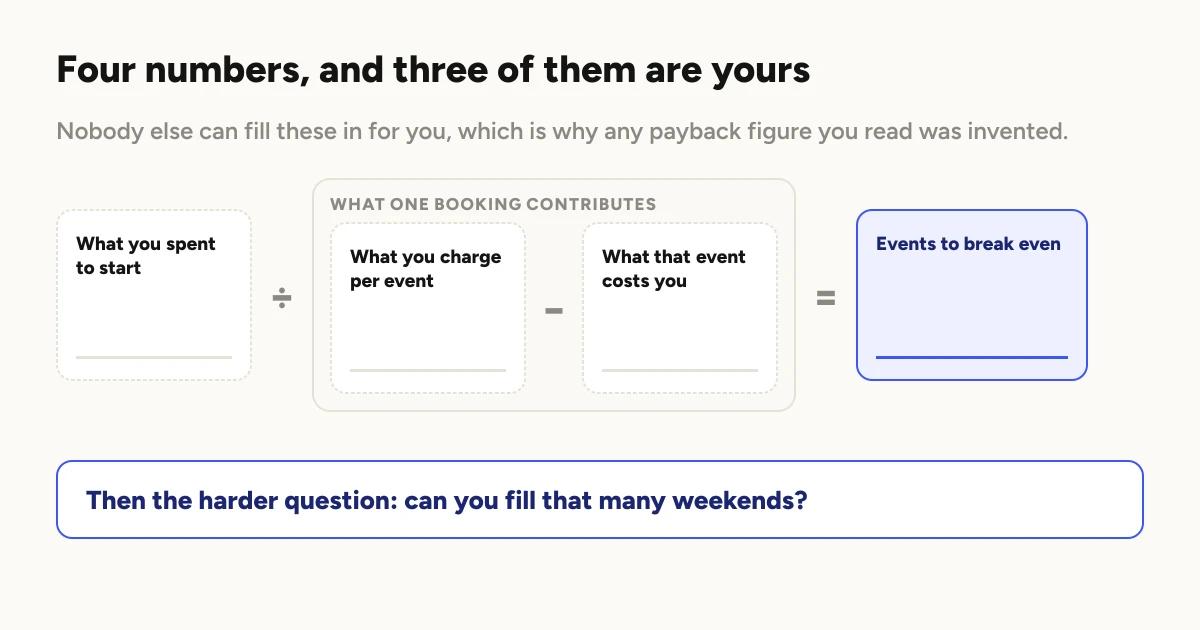
Only four figures, and three of them are yours.
What you spend to start. Not just the rig. The phone you dedicate to it,
lighting, power and transport, insurance, software, and a case that survives a
car boot. Our
breakdown of what a 360 booth actually costs
lists what most people forget.
What you charge per event. If you have not set this yet, work it out first,
because everything below depends on it.
What to charge for a 360 booth is the
long version.
What each event costs you to run. Fuel, parking, an assistant if you use
one, consumables, and the hours you spend delivering afterwards rather than
standing at the booth.
Subtract the second from the third. That is what one booking actually
contributes. Divide your startup total by it, and you have the number of events
it takes to get your money back.
That number is yours and it is real. Any figure you did not calculate this way
is decoration.
The part the arithmetic hides
Here is the thing that matters more than any of the above.
The equipment is not what decides this. Bookings are.
Two operators with identical rigs, identical prices and identical costs will
get completely different answers to this question, because one of them gets
booked twice a month and the other gets booked twice a year. The spreadsheet
is the easy half. Filling the calendar is the actual business, and it is the
half that a rig purchase does nothing to solve.
This is why the honest answer to "is it worth it" is usually a question back:
do you already have a way to reach the people who book these? If you run
events already, or you have a following, or you have a venue that will
recommend you, the arithmetic above is likely to work. Starting from nothing,
the equipment is the cheap part of what you are taking on.
Where 360 booth bookings actually come from
is the companion to this article, and it is the harder one.
Why is the second season cheaper than the first?
Worth knowing while you are doing the sums, because it changes the shape of
the answer.
Most of your startup list is bought once. The rig, the case, the lighting and
the phone carry into next year. What repeats is software, insurance, transport
and your time.
So the first season carries nearly all the cost and the second season looks
very different. If your break-even number is more events than you can plausibly
book in one year, that is not automatically a no. It is a longer horizon, and
the question becomes whether you will still want to be doing it.
When is the answer no?
An article on this that never says no is an advertisement, so here is the
honest side.
If you need it to pay back fast, it probably will not. This is weekend
work, and there are only so many weekends.
If you are buying to find out whether you like the work, hire a booth for a
job first, or work an event for someone who already runs one. That costs a
fraction of a rig and answers the third question at the top.
If the plan depends on being the cheapest, the arithmetic gets much worse,
because your contribution per event shrinks while your costs do not.
If you cannot name where your first three bookings come from, that is the
problem to solve first. It is solvable, and it is cheaper to solve before you
own equipment than after.
How can you test it before buying?
The cheapest version of this decision is available to you now.
Price a package as though you were selling one. Put it in front of the people
you would sell to. See whether anybody asks about dates. You will learn more
about whether this is worth it in a fortnight of asking than in any article
about market growth, including this one.
The short version
The arithmetic is simple, it is four numbers, and three of them are yours.
The answer it produces is only as good as your booking rate, which is the part
nobody can sell you. Work out your own break-even number, then be honest about
whether you can fill that many weekends. That is the whole of the question.
Keep reading
What is a 360 video booth?
Two names, mostly one product. A 360 video booth and a 360 photo booth are usually the same machine, but a plain video booth is something else entirely. Here is how to tell what you are looking at.
Read more →
Snap360 alternatives, compared
Snap360 is a capable 360 booth app with an unusually generous free tier. The differences worth knowing are cloud storage, how many devices you can run, and what offline actually means.
Read more →
Your first 360 booth event: what actually happens
Most advice for new operators stops at the sale, because most of it is written by people selling rigs. This is the part after that, in the order it actually happens.
Read more →