
What to charge for a 360 booth, and what to include
Nobody can tell you your rate, and anyone who quotes one has not seen your costs. Here is the method, and the twelve things operators forget to charge for.
There is no correct price for a 360 booth. It depends on your city, your
costs, your competition and what else you do. Any article that gives you a
number has not seen any of those.
What can be useful is the method, and the list of things operators leave out
of a quote and then absorb.
The short answer: most underpricing is not a low hourly rate. It is unpaid
hours and unbilled extras attached to a rate that looked fine.
Should you charge by the hour or by the day?
An event is not the hours you are booked for. Work out the real length of a
job before you price it.
Load the van. Drive there. Park, often badly. Carry it in. Set up. Wait,
sometimes for hours, because you were told to be set up before guests arrive
and the booth is not wanted until after dinner. Run it. Pack down, usually
at midnight. Drive home. Unload. Charge everything. Then, afterwards, deal
with the clips.
A four hour booking is rarely a four hour day. If your rate divides your
fee by the booked hours, you are calculating a number that does not describe
your life.
Time one real event, door to door, including the next morning's admin. That
number is what you are actually selling.
What do operators forget to charge for?
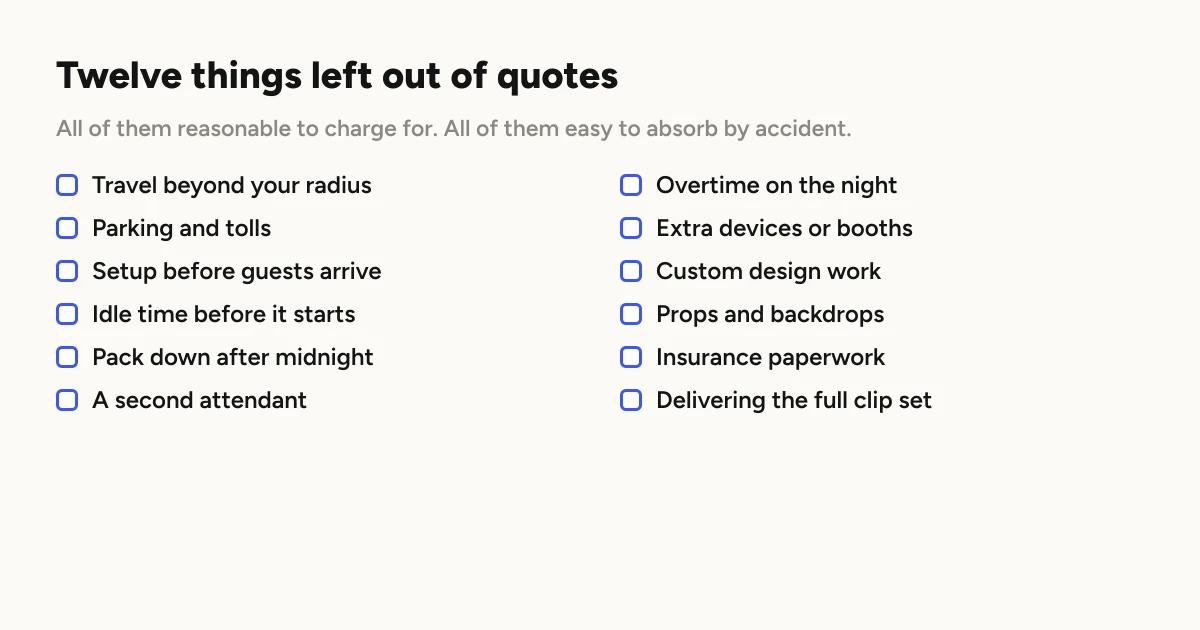
Each one is defensible. The problem is never that a client refuses. The
problem is that it was never mentioned, so it becomes free by default.
Two worth calling out because they are the most commonly absorbed:
Idle time. Being set up at 5pm for a booth nobody uses until 9pm is four
hours of your day. Either bill it, or agree a later setup, but do not let it
be invisible.
The work after the event. Uploading, sorting, and delivering the full set
to the client is real time on a real day. If you offer it, price it.
What should be in the package?
A package that includes everything is easy to sell and easy to lose money on.
A package that includes almost nothing is annoying to buy.
The useful split is by what actually varies.
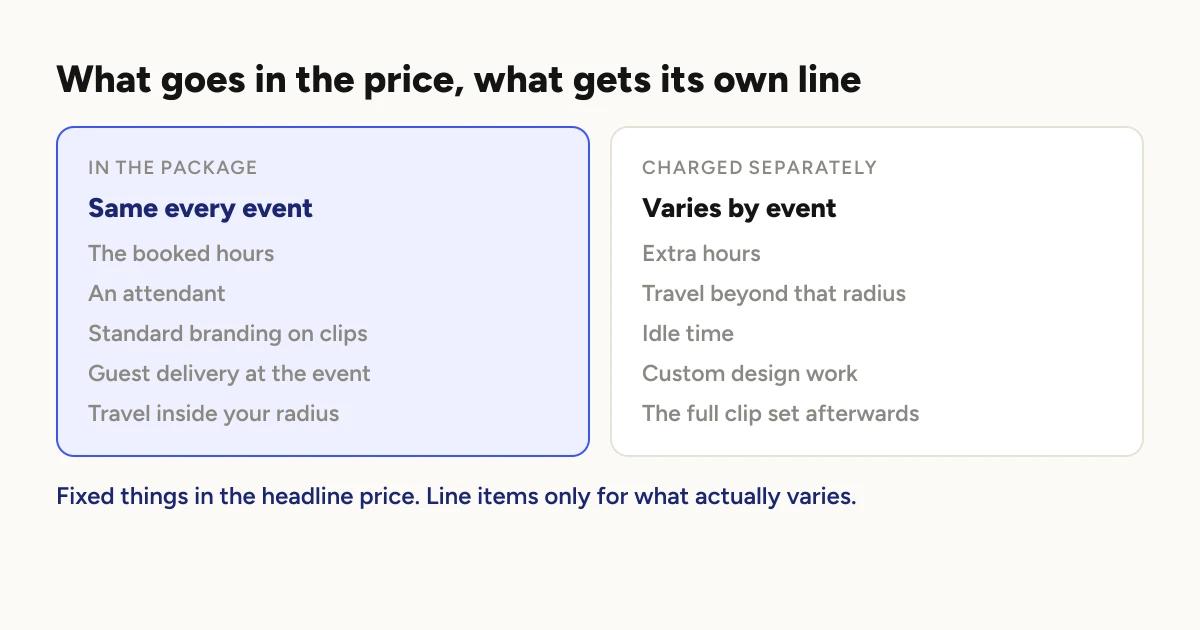
The principle: anything that varies with the event gets its own line.
Anything that is the same every time belongs in the headline price, because
line items for fixed things just make you look expensive.
Put the boring things in writing
Not to be difficult. Because these are the ones that cause an awkward
conversation on the night, and the awkwardness is always about the thing
nobody wrote down.
Worth stating in every quote: how many hours, when setup happens and whether
it counts, what the overtime rate is, what you need from the venue, when the
client receives the clips, and what happens if the venue has no usable
connection. That last one changes what you can deliver, and it is much
better raised at quote stage than discovered at the event.
Running a booth with no wifi
covers what actually changes.
Why is the cheapest quote a bad position?
In a format where the visible output is the product, price is read as a
quality signal. Being the cheapest tells a prospective client something you
probably do not want to tell them.
There is also a practical problem. Cheap bookings are not smaller versions of
good bookings. They take the same day, the same drive and the same pack down,
and they leave you no room for the event that runs long.
If you want to win on something other than price, the things clients
actually notice are turning up early, being easy to deal with, and the clips
looking good enough that guests post them. That last one is also your
marketing, which is why
where bookings come from
is really a pricing question too.
What should you check before sending a quote?
Four questions, and if any answer is no, the number is probably wrong.
Does this cover the whole day, not the booked hours?
If they add an hour on the night, do I know what I am charging?
If this event is 90 minutes further away than usual, is that in the price?
If I did four of these a month, would that be a business or a hobby?
That last one is the real test. A rate that works once is not a rate. A rate
that works forty times a year, including the ones that run late, is.
What this does not tell you
A number. Deliberately.
Your costs, your market and your competition are local, and a figure from an
article written somewhere else is worse than useless because it feels like
information. What travels between markets is the method: price the day,
itemise what varies, write down the boring things, and check the rate
against a full year rather than a good night.
If you are still working out what the equipment side costs,
what a 360 photo booth actually costs
covers the buying side, including the parts that never appear in a listing.
Keep reading
What is a 360 video booth?
Two names, mostly one product. A 360 video booth and a 360 photo booth are usually the same machine, but a plain video booth is something else entirely. Here is how to tell what you are looking at.
Read more →
Snap360 alternatives, compared
Snap360 is a capable 360 booth app with an unusually generous free tier. The differences worth knowing are cloud storage, how many devices you can run, and what offline actually means.
Read more →
Your first 360 booth event: what actually happens
Most advice for new operators stops at the sale, because most of it is written by people selling rigs. This is the part after that, in the order it actually happens.
Read more →