
Where 360 booth bookings actually come from
Your product is the only thing at the event that guests publish themselves. That changes where bookings come from, and most operators leave the mechanism switched off.
Most advice about getting more photo booth bookings is general small business
advice with the words photo booth added. Post consistently. Network. Ask for
referrals. None of it is wrong and none of it is about this format.
A 360 booth has one structural advantage that almost nothing else at an event
has, and it is worth building around.
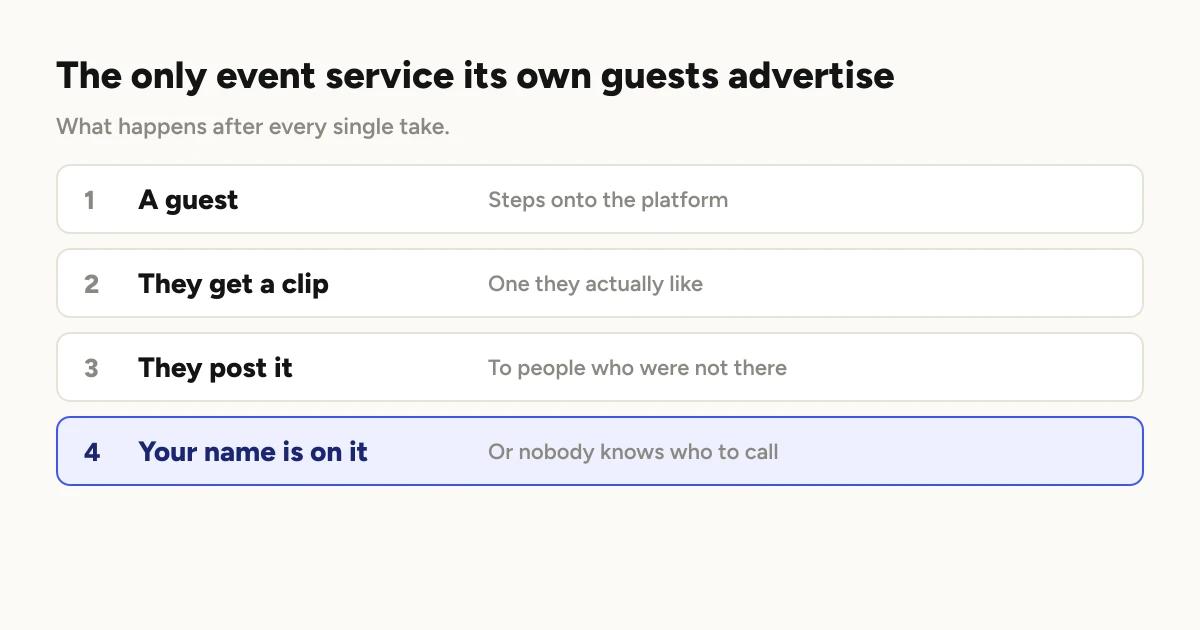
Your customers' guests publish your product for you
Think about who gets seen at a wedding. The DJ does not get posted. The
caterer does not get posted. The florist might, in the background of someone
else's photo.
Your output is the thing guests post themselves, deliberately, to their own
audience, on the same night. Every guest who steps on the platform is a
person who will voluntarily distribute a sample of your work to people who
were not there.
Nothing else you can buy for an event does that. It means your marketing
problem is not really reach. It is making sure the reach you are already
generating points back at you.
Which it does not, by default
A clip that goes out with no branding on it advertises the format, not the
operator. Someone sees it, decides they want one, and has no idea who to call.
So the first job is making sure your name travels with the clip. That means
an overlay, an intro or outro, or a logo, so the video that lands on a
stranger's feed carries yours.
On the free plan the app puts its own watermark on clips and leaves your
logo and overlay artwork off, so the guest is posting a clip branded for
Logibooth rather than for you. That is the entire difference Pro makes, and
it is the reason to turn it on the week you have a paid event rather than
before.
What Pro changes covers it exactly,
and the pricing page has the current cost.
What should you ask a guest for, and when?
There is a single moment at a booth when a guest is happiest: standing there,
phone out, about to receive something they like. Everything you want from a
guest is easiest at that moment and much harder at any other.
The app puts three things there.
A follow. The social gate asks a guest to follow your account right then.
Pick the one account you actually post to, because a guest will follow one
thing at a booth, not three.
Contact details. The one thing that turns an event into a list you own
rather than an audience the platform rents you. It exports as a spreadsheet.
A review invitation. Asked at the end, from someone who has just enjoyed
themselves, which is worth considerably more than an email chased three weeks
later. Keep it an invitation. It should always be skippable, and marketing it
as anything else is both against the review platforms' rules and a bad look.
Which setting is silently switched off?
Worth checking today: a gate with no link set is skipped silently. Guests
never see it, and nothing tells you it did not run.
That means an operator can believe the follow prompt is working for months
while every guest has been going straight to their download. It costs nothing
to check and it is the single highest value five minutes in this article.
Growing your following
and getting more reviews
cover the setup.
Which bookings actually repeat?
Guest posts bring individual enquiries. Other vendors bring calendars.
A couple books you once. A wedding planner, a venue coordinator or an events
agency can put you in front of many bookings a year, and they choose suppliers
on reliability rather than on price.
What actually earns that: turning up when you said, packing down without
being asked twice, not blocking a service door, and being easy to deal with
on the night. Planners talk to each other about who is a problem.
A practical move that costs nothing: send the venue and the planner a few
of the best clips from the night, unbranded by anything except you. They
need content too, and you have just made some.
What asset are you already sitting on?
After an event you are holding the best marketing material you will get all
month, and most operators leave it sitting on a phone.
A short reel from a real event beats any stock demo, because prospective
clients want to see what their event will look like rather than what a booth
can do in a studio.
Making a promo reel
covers pulling one together from clips you already have.
Ask the client before you post recognisable guests. Most say yes. Asking is
what keeps them saying yes.
What is overrated?
Paid ads before you have a portfolio. Spending to send strangers to a
page with three clips on it is expensive learning.
Being on every platform. One account you post to consistently beats four
you neglect, and guests will only follow one anyway.
Competing on price. In a format where the visible output is the product,
being the cheapest signals exactly what you would expect it to signal.
The compounding part
The reason this format rewards patience: every event you run produces the
material to book the next one, but only if your name is on the clips, the
prompts are actually switched on, and you asked the planner for five minutes
of their time.
None of that is a campaign. It is a setup you do once and a habit you keep.
Keep reading
What is a 360 video booth?
Two names, mostly one product. A 360 video booth and a 360 photo booth are usually the same machine, but a plain video booth is something else entirely. Here is how to tell what you are looking at.
Read more →
Snap360 alternatives, compared
Snap360 is a capable 360 booth app with an unusually generous free tier. The differences worth knowing are cloud storage, how many devices you can run, and what offline actually means.
Read more →
Your first 360 booth event: what actually happens
Most advice for new operators stops at the sale, because most of it is written by people selling rigs. This is the part after that, in the order it actually happens.
Read more →