
The questions clients ask about 360 booths, and good answers
Written so you can send it to a client. Twelve questions people actually ask before booking a 360 booth, answered plainly, including the ones with no single answer.
If you are booking a 360 photo booth, this is written for you. If you run one,
it is written so you can send someone the link instead of typing the same
answers again.
Some of these have a real answer. Some depend entirely on the operator, and
for those the useful thing is knowing what to ask and what a good answer
sounds like. Both kinds are marked.
What actually is it?
A low platform that guests stand on, with a motorised arm that carries a
camera around them while it records. Software turns those few seconds into a
slow motion clip that guests can post.
The camera is usually a phone. That is not a shortcut, it is how most of these
work, and it is why the video looks the way it does.
How a 360 photo booth works has the
longer version.
How much space does it need?
More than the platform. The arm sweeps a wider circle than the base, and
guests need room to step on and off without walking into it.
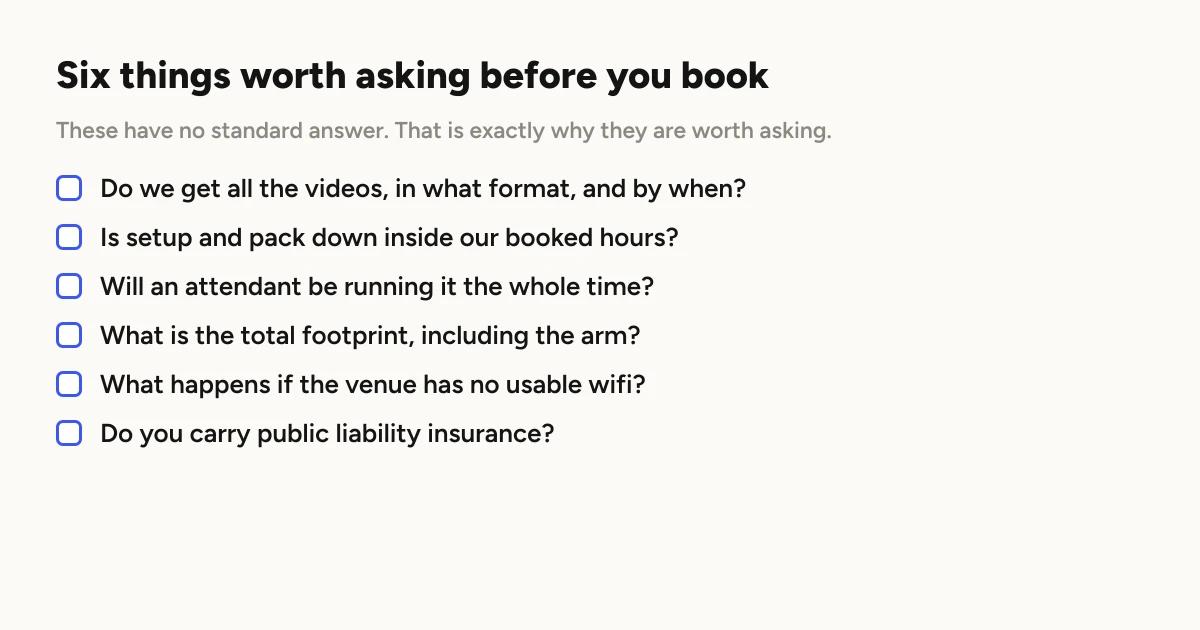
Ask your operator for the total footprint including the arm, not the
platform size. Also ask about ceiling height if your venue has beams or low
sections.
You will also need a power point nearby and a flat, solid floor. A spinning
arm on an uneven surface is both a wobbly video and a safety problem.
How many of our guests will actually use it?
Fewer than you expect, and in waves.
Each turn takes longer than the recording does, because it includes stepping
on, handing drinks to someone, working out who stands where, doing the take,
sometimes doing it again, and stepping off. The recording is the shortest part.
Be wary of a confident number. Throughput depends on the operator, whether
there is an attendant, how clips are delivered, and how much your guests
linger. Anyone quoting an exact guests-per-hour figure without asking about
your event is guessing.
A better question: will there be an attendant running it the whole time?
An attended booth moves several times faster than an unattended one.
How long should we book it for?
Long enough to cover the part of the night when people are in the mood, which
is usually after dinner rather than during arrivals.
Ask whether setup and pack down happen inside your booked hours or outside
them. This varies between operators and it is worth knowing before you compare
two quotes.
Do we get all the videos afterwards?
Ask. Do not assume. This one genuinely differs between operators, and it
is the single most common source of disappointment after an event.
The technology is not the limit. An operator can hand over the complete set
as a download, and the contact details collected on the night as a
spreadsheet. Whether they include that in your package is a business
decision, not a technical one.
Good follow-up questions: how soon after the event, in what format, and for
how long is the link available?
Can it have our names or our logo on it?
Yes. Clips can carry a custom overlay, an intro, an outro, and a soundtrack.
For a wedding that usually means names and a date framing the video. For a
brand activation it means the logo and campaign artwork.
Ask to see an example of a clip they have branded before, rather than a
stock demo.
What if the venue has bad wifi?
This is worth raising early, because the honest answer changes what you get.
Guests can still get their videos. A well prepared operator can deliver
clips over their own equipment without any internet at all.
What gets lost is the contact collection. If part of your reason for
having the booth is collecting guest emails, a venue with no connection
changes that, and you should know before the night rather than after.
If your venue is a basement, a marquee, or an old building with thick walls,
tell your operator now.
Running a booth with no wifi is the
operator side of this if you are curious.
Can guests post straight to Instagram?
Usually they get the clip onto their own phone, and post from there. That is
a good thing: it is their account, their caption, and their audience.
Ask how guests receive the clip. A QR code at the booth, a text or email link,
and a separate collection station are all normal. A separate station keeps the
queue moving.
Is it safe? What about older guests?
The platform is low, but it is still a step up, and the arm is moving.
Reasonable expectations: an attendant present whenever it is running, guests
kept clear of the arm's path, and a stable floor. Ask what they do about
guests who cannot easily step up, because a good operator will have an
answer rather than a shrug.
If you are serving alcohol all night, an attendant is not optional.
How long is each video?
The recording is a fixed short burst, typically around ten seconds, and the
finished clip is short by design. That is what slow motion requires rather
than a stylistic choice.
Why a 360 clip is ten seconds explains
it if you want the detail.
Do we need to provide anything?
Usually power, floor space, and somewhere to park and unload. Sometimes a
table for a collection station.
Ask whether they need a meal for a long event, whether they need access before
guests arrive, and how long setup takes. None of these are unreasonable, but
all of them are easier agreed in advance.
What happens if something breaks?
Ask it. The answer tells you a lot.
A good answer involves spares, a backup phone, and a plan. A vague answer is
itself information. Also ask whether they carry public liability insurance,
because many venues require it and will ask you, not them.
For the operator sending this
Two of these questions are the ones that generate complaints after the event
rather than before it: whether the client gets the full set of clips, and
what happens to contact collection at a venue with no connection. Both are
easy to answer honestly in advance and awkward to explain afterwards.
If you are handing over a full set,
delivering clips to your client
covers the export, including the check worth doing before you send it.
Keep reading
What is a 360 video booth?
Two names, mostly one product. A 360 video booth and a 360 photo booth are usually the same machine, but a plain video booth is something else entirely. Here is how to tell what you are looking at.
Read more →
Snap360 alternatives, compared
Snap360 is a capable 360 booth app with an unusually generous free tier. The differences worth knowing are cloud storage, how many devices you can run, and what offline actually means.
Read more →
Your first 360 booth event: what actually happens
Most advice for new operators stops at the sale, because most of it is written by people selling rigs. This is the part after that, in the order it actually happens.
Read more →